
Before Volt Typhoon, There Was Breakpoint
Richard A. Clarke’s 2007 novel reads less like cyber fiction today and more like an early warning about infrastructure, misdirection, and escalation.

Some thrillers age badly because the technology moves on; Breakpoint ages badly because the technology caught up.
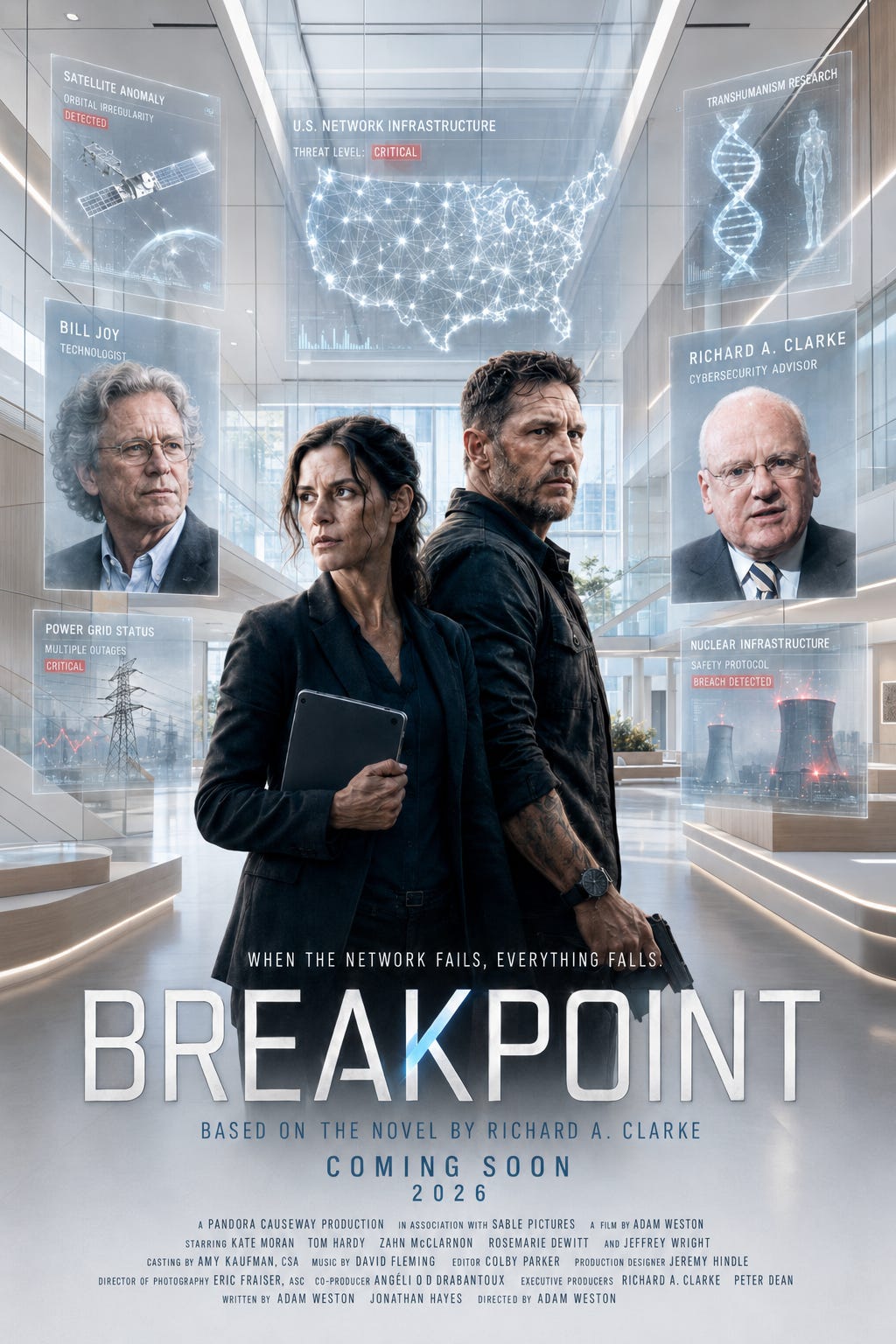
There is a lot to love in this novel. Richard A. Clarke, whom the Cybersecurity Canon recognized with its Lifetime Achievement Award, jams a boat-load of cutting-edge cybersecurity ideas into this little Crichton-esque political thriller. Clarke uses cyber as the delivery mechanism for a bigger question: what happens when society cannot govern technologies that arrive faster than its moral, legal, and geopolitical institutions can absorb them? It’s kind of a warning for what we are all experiencing with AI today.
By Crichton-esque, I mean Michael Crichton, the guy probably best known for writing the novel, “Jurassic Park.” During his lifetime, though, he wrote many near-future books that took a new technological idea into the near future to see what would happen. Books such as “State of Fear,” “Prey,” “Timeline,” “Airframe,” and “Disclosure,” were some of my favorites.
Breakpoint is in the same genre. It’s not a must-read for cybersecurity professionals, but it’s an entertaining story you can hand to family members, friends, and bosses to illustrate what a well-resourced adversary could do in cyberspace. Along the way, you will learn a little about the ethical issues, pro and con, surrounding the Transhumanist Movement (the advocacy of using performance enhancement technology to influence human evolution), and you will enjoy a rollercoaster of a ride as the heroes attempt to determine who the bad guys are and how to stop them.
When I say there is a boat-load of information, I am talking about yacht-sized, not dinghy-sized. The bad guys in this novel execute most of the cyber fantasy attacks against the United States that any group of cybersecurity geeks (including myself) could conjure up after a few beers sitting around a bar at the annual Black Hat / DEFCON conventions in Vegas (one of the settings in the book). Clarke gives us bombings of US beachhead routers on both coasts that reduce inbound and outbound internet traffic to just 10%, buffer overflow attacks against a communications satellite that sends it reeling in to space, SCADA attacks that blow up a research institution with a live nuclear reactor, and a well-coordinated SCADA attack that takes out all power west of the Mississippi. Of course, in the novel, US government leadership, specifically the Intelligence Community (IC), thinks the Chinese are behind everything.
The individual attack classes are plausible; the novel compresses them into a coordinated, cinematic campaign. Some experts believe that the Chinese government might execute something similar to these attacks in an effort to dissuade the U.S. government from coming down on the wrong side of the “Taiwan” issue. Clarke would know. Before he retired from government service, he served three different Presidents as the Special Assistant to the President for Global Affairs, the National Coordinator for Security and Counterterrorism, and the Special Advisor to the President for Cybersecurity.
The political theory behind these acts is something called Escalation Dominance. It’s the idea that China, or any government really, would launch some kind of attack against the U.S. that would hurt the country in an effort to prove that they could launch a much larger attack that would really hurt if the US did something that China didn’t like. In the afterword to this novel, Clarke says that it was easier to talk about these issues in a fictional form than it was to talk about them in dry, academic, and political journals. I concur. They are much more exciting and frightening splashed across the fictional page.
The cyber ideas in this novel are not what the story is ultimately about, however. They are just the means to an end. [SPOILER ALERT] It turns out that the bad guys are not the Chinese. The real bad guys are a group of people that are not too keen on something called the Transhumanist Movement: a philosophy that espouses using genomics, robotics, informatics, nanotech, and new-pharma to change humanity into a new species. They are worried about the religious and moral implications of man being directly involved in deciding the next steps in human evolution and they have a billionaire benefactor (doesn’t that sound prescient) who can fund their terrorist operations. His name is Will Gaudium. In the novel, Gaudium is one of the original Internet founding fathers and made his fortune with an internet startup. I believe, though, that Clarke based Gaudium on a real-world guy by the name of Bill Joy.
Bill Joy is really one of the Internet founding forefathers. He created vi, the original UNIX text editor. He had a big hand in creating BSD UNIX, a major branch of the Unix family and an important predecessor in the open-source operating-system movement. And for all intents and purposes, created the first working software implementation of the TCP/IP stack. He went on to co-found Sun Microsystems; a company that built some of the most beautiful UNIX machines of the time. And then, out of nowhere, he wrote an article for Wired Magazine decrying the Transhumanist Movement.
To have somebody of that stature, a legend really, come out against the advancements of science made the entire scientific community pause for a beat. Some compared Joy’s manifesto to Einstein’s postwar warnings about atomic weapons, especially his 1946 New York Times Magazine interview, later circulated by the Emergency Committee of Atomic Scientists as “Only Then Shall We Find Courage.” Like Einstein, Joy was a technologist warning that human institutions and moral judgment were not keeping pace with the destructive power of the technologies we were building.
I may be wrong, but the resemblance between the real-world Bill Joy and the fictional Will Gaudium is unmistakable.
Clarke’s story races across 10 days in March of 2012 as our heroes, Susan Connor (an agent for the Intelligence Analysis Center (IAC)) and Jim Foley (an ex-marine on loan to the IAC from the NYPD), try to outthink the U.S. Intelligence Apparatus and Law Enforcement community and track down the real culprits behind the Internet attacks.
Critics have taken Clarke to task for his wooden characters in the story, but I found that not to be true. I liked his portrayal of the misguided internet billionaire especially and I liked the way he portrays New York and Boston cops. And I really appreciated that he did not try to establish some sort of romantic relationship between Foley and Connor. Foley is a little flat as a character, but I am OK with that.
The bottom line here is that this novel is a fun political thriller that gets the cybersecurity stuff right. I recommend it. It still holds up nearly two decades later.
Books by Richard Clarke
Hall of Fame Books
Richard A. Clarke, Robert K. Knake, 2010. Cyberwar: The Next Threat to National Security & What to Do About It [2017 Canon Hall of Fame Book]. Goodreads URL: https://www.goodreads.com/book/show/7286217-cyberwar
Richard A. Clarke, Robert K. Knake, 2019. The Fifth Domain: Defending Our Country, Our Companies, and Ourselves in the Age of Cyber Threats [2020 Canon Hall of Fame Book].
Goodreads URL: https://www.goodreads.com/book/show/42584184-the-fifth-domain
Canon Review URL: https://cybercanon.org/the-fifth-domain-defending-our-country-our-companies-and-ourselves-in-the-age-of-cyber-threats/
Amazon Link: https://amzn.to/3K5kXtr
Other Books and Novels
Richard Clarke, 2004. Against All Enemies: Inside America’s War on Terror [Book]. Goodreads, URL: https://www.goodreads.com/book/show/88667.Against_All_Enemies_
Richard Clarke, Glenn Aga, Roger Cressey, Stephen Flynn, Blake Mobley, Eric Rosenbach, Steven Simon, William Wechsler, Lee Wolosky, 2004. Defeating the Jihadists: A Blueprint for Action [Book]. Goodreads, URL: https://www.goodreads.com/book/show/253548.Defeating_the_Jihadists
Richard A. Clarke, 2005. The Scorpion’s Gate [Book]. Goodreads, URL: https://www.goodreads.com/book/show/979544.The_Scorpion_s_Gate
Richard A. Clarke, 2008. Your Government Failed You: Breaking the Cycle of National Security Disasters [Book]. Goodreads, URL: https://www.goodreads.com/book/show/3057951-your-government-failed-you
Richard Clarke, 2014. Sting of the Drone [Book]. Goodreads, URL: https://www.goodreads.com/book/show/18404117-sting-of-the-drone
Richard A. Clarke, Michael J. Morell, Geoffrey R. Stone, Cass R. Sunstein, Peter Swire, 2014. The NSA Report: Liberty and Security in a Changing World [Book]. Goodreads, URL: https://www.goodreads.com/book/show/20668828-the-nsa-report
Richard Clarke, 2015. Pinnacle Event [Book]. Goodreads, URL: https://www.goodreads.com/book/show/23014645-pinnacle-event
Richard A. Clarke, R.P. Eddy, 2017. Warnings: Finding Cassandras to Stop Catastrophes [Book]. Goodreads, URL: https://www.goodreads.com/book/show/32600755-warnings
Richard A. Clarke, 2022. Artificial Intelligencia [Book]. Goodreads, URL: https://www.goodreads.com/book/show/58496109-artificial-intelligencia
Source
Richard Clarke, 2007. Breakpoint [Book]. Goodreads, URL: https://www.goodreads.com/book/show/88666.Breakpoint
References
Andrew Leonard, 2000. BSD Unix: Power to the people, from the code [History]. Salon, URL: https://www.salon.com/2000/05/16/chapter_2_part_one/
Ashlee Vance, 2003. Bill Joy’s greatest gift to man – the vi editor [Website Article]. The Register, URL: https://www.theregister.com/software/2003/09/11/bill-joys-greatest-gift-to-man-the-vi-editor/665421
Bill Joy, 2000. Why the Future Doesn’t Need Us [Essay]. Wired, URL: https://www.wired.com/2000/04/joy-2/
ALBERT EINSTEIN (Chairman), HAROLD C. UREY (Vice-Chairman), HANS A. BETHE, HARRISON BROWN, T. R. HOGNESS, PHILIP M. MORSE, LINUS PAULING, FREDERICK SEITZ, LEO SZILARD, V. F. WEISSKOPF (Trustees), 1947. The Threat of Atomic War between Nations [Historical Document]. EMERGENCY COMMITTEE of ATOMIC SCIENTISTS - National Archives, URL: https://www.archives.gov/college-park/highlights/einstein-letter
Malcolm Gladwell (Author), Andy Ross (Editor), 2008. Bill Joy [Essay]. Andy Ross, URL: https://www.andyross.net/bill_joy.htm
Robert S. Ross, 2002. Navigating the Taiwan Strait: Deterrence, Escalation Dominance, and U.S.-China Relations [Paper Repository]. JSTOR - MIT Press, URL: https://www.jstor.org/stable/3092143
Spencer Reiss, 2003. Hope Is a Lousy Defense [Essay]. Wired, URL: https://www.wired.com/2003/12/billjoy/
Staff, No Date. The Official Site of Michael Crichton [Vanity Website]. MichaelCrichton.com, URL: https://michaelcrichton.com/
Staff, 2023. Richard A Clarke.Net [Vanity Website]. Richard A. Clarke, URL: https://richardaclarke.net/
Staff, 2026. Black Hat USA 2026 [Conference Website]. Black Hat / Informa Festivals, URL: https://blackhat.com/us-26/
Staff, 2026. DEF CON® Hacking Conference Home [Conference Website]. DEF CON, URL: https://www.defcon.org/
Note about Using AI for this Essay
I used ChatGPT to
Check for grammar and spelling errors.
Flag passive voice.
Suggest changes to awkward sentence construction.
Create images.
Fact-check
Stress-test my thesis