
Forget Bletchley Park: America's Codebreakers Were Women
A Review of Liza Mundy's "Code Girls"

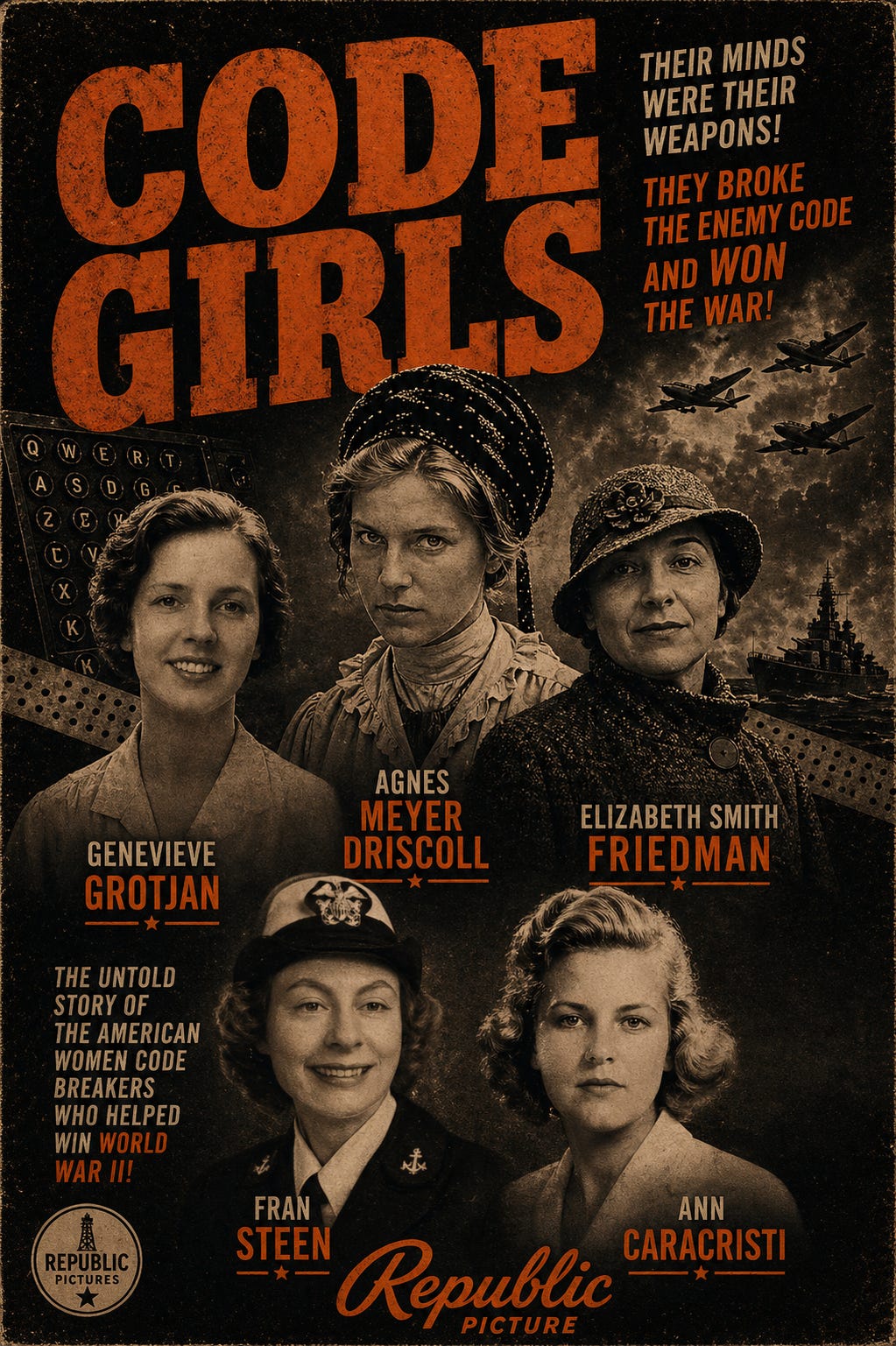
I’ll start with the verdict: the Cybersecurity Canon Committee got this one exactly right. Code Girls: The Untold Story of the American Women Code Breakers Who Helped Win World War II absolutely belongs in the Hall of Fame, and I wholeheartedly endorse its induction.
If you think the history of cryptology in World War II begins and ends at Bletchley Park and Alan Turing, this book will correct that assumption fast. Mundy pulls back the curtain on a parallel American effort. They ran it at scale, under extreme secrecy, and it was largely powered by women. These exceptional cryptanalysts performed the bulk of the operational code breaking that helped win the war. This isn’t just a recovery of forgotten history; it’s a recalibration of where the real work got done.
I’ve been a fan-boy to the WWII code breaking efforts at Bletchley Park for many years now. Alan Turing is a personal computer science hero of mine. I first heard about his Enigma-busting exploits against German codes in my favorite hacker novel of all time, 1999’s Cryptonomicon, written by the Cybersecurity Canon Lifetime Achievement author, Neal Stephenson. Of course, the excellent 2014 movie The Imitation Game with Benedict Cumberbatch playing Turing is one of my favorites.
Sometimes it’s the people no one imagines anything of who do the things that no one can imagine. - The Imitation Game
It turns out that an entire group of other people that no one imagined anything of were doing similar work in the United States. I always knew that there were like-minded efforts going on in the Pacific Theater. I heard rumors of the Americans breaking various codes, like the team working for William Friedman that solved the Japanese Purple code, and the efforts of Joe Rochefort breaking the JN-25 code that led to victory at the Battle of Midway. But I never found any books that told that story. Well, now I have. “Code Girls” by Liza Mundy is a treasure.
We learn from Mundy that cryptography is the art and science of code making, cryptanalysis is the discipline of code breaking, and cryptology captures both skill sets. Mundy describes Code Girls who operated primarily as cryptanalysts.
The remarkable characteristic about the “Code Girls” story is that despite the heroic efforts of Friedman and Rochefort, the day-to-day work of deciphering Japanese and other nations’ codes during WWII was largely done by American women, civilians at first and then in collaboration with the newly formed WAVES (Women Accepted for Volunteer Emergency Service in The United States Naval Reserve) and the WAACs (Women’s Army Auxiliary Corps) that came into service in 1942.
While military and civilian men mostly got the credit, it was these formidable women who ran the show. And their efforts were so secretive, that many went to their grave without telling their loved ones what they did during the war. Family and friends thought that the “Code Girls” just did administrative work.
Mundy is able to tell the stories of some 20+ women, what they did with their cryptanalyst efforts, and how they lived their lives. Let me just highlight six of the superstars.
The Women
Agnes Meyer Driscoll:
One of the great cryptanalysts of all time.
Made major breakthroughs against Japanese naval cryptosystems in the 1920/30s.
Cursed like a sailor (Similar to Admiral Grace Hopper).
She was known for saying that any man-made code could be broken by a woman.
Note: Sounds like a similar line from “The Return of the King” movie.
Witch-king: “No man can kill me” ‘
Éowyn: “I am no man,” before striking him down.
Early work on Japanese naval codes was foundational to later team-based successes against JN-25.
Mentored and influenced a generation of Navy cryptanalysts, many of whom later received the credit.
Learned how the Japanese disguised their fleet code, using a method called “superencipherment,” that involves both a code and a cipher.
In 1937, she suffered a car crash that broke her leg badly, as well as both jaws. It took her a year to recover, and in some ways she never did. Many people felt her personality changed following her ordeal.
In 1940, the Navy took her off JN-25 and assigned her to an independent U.S. solution of Enigma, but her efforts lagged behind the more advanced British program.
After the war, the Navy revered her work yet marginalized her role and didn’t seem to know what to do with her.
Elizebeth Smith Friedman
Was part of the early Riverbank Laboratories effort that helped establish modern U.S. cryptanalysis.
Broke rumrunner codes during Prohibition for the U.S. Coast Guard that resulted in successful prosecutions. In court, she testified as an expert witness.
Married to William Friedman, the man who supervised the breaking of the Purple Code. Mundy makes a strong case that Elizabeth may have been the more naturally gifted early cryptanalyst and likely influenced William Friedman’s development.
Variously employed by the Justice and Treasury Departments, the Customs Bureau, the Coast Guard, and other agencies
Genevieve Grotjan
In September 1940, played the key role in identifying the pattern that enabled the U.S. to break the Japanese Purple code (Codename: Magic) that enabled sustained insight into Japanese diplomatic communications throughout much of the war.
Ann Caracristi
A problem-solving prodigy, intellectually ferocious, Annie worked twelve-hour shifts, day after day.
As a 23-year-old, became the head of an Army research unit.
One of only a few superstars who were asked to stay on after the war.
Matched wits against Japanese code makers, solving message addresses and enabling military intelligence to develop “order of battle” showing the location of Japanese troops.
Broke the Japanese Army address code system and excavated code groups revealing the place names of where Japanese Army units were located.
She had this mesmerizing thing she could do, flipping a pencil between her fingers and never dropping it (Like Boris Grishenko, played by Alan Cumming, in the James Bond movie GoldenEye.
Wilma Berryman, later Wilma Davis
Helped Ann Caracristi break the Japanese Army address code system.
Fran Steen, Later Suddeth Josephson
Helped break the inter-island cipher JN-25 code (Code name: Pretty Weather) that facilitated the assassination of General Yamamoto.
The Codes
JN-20: A lower-level naval cipher system; regional/logistical communications. Cracking aided in the naval battle at Midway.
JN-25: Primary an imperial Japanese Navy operational code; strategic, fleet-level, war-winning intelligence; Cracking led to assassination of General Yamamoto.
2468: Water transport code. Cracking led to revealed supply chains and vulnerabilities.
2345: Weapons logistics. Cracking exposed the Japanese Army’s logistics backbone.
3366: – Aviation code: Cracking led to aircraft movement and support
5678: High-volume, widely used Japanese Army communications system, Cracking helped pattern recognition to increase confidence.
6666: Isolated or cut-off Japanese forces (late war). Cracking led to insight into degraded, fragmented command structures.
6789: Promotions/transfers. Cracking led to an understanding of unit structure; specifically leadership changes
7777: A theater-level Japanese Army communications system, associated with regions like the Southwest Pacific. Cracking led to understanding regional priorities, command relationships, and coordination between units in a specific battle space.
I have two minor nitpicks about the book. The first is that Mundy tells a scattered story. If the reader wants to hear about the extraordinary accomplishments of, say, Ann Caracristi, there is not one place to look. You have to pick it up in fragments as you read the book. I found that to be frustrating. Second, Mundy devotes significant space to the personal and social lives of the Code Girls; their friendships, relationships, and life transitions alongside the war. That context will resonate with many readers and adds human depth to the story. For my purposes, though, I would have preferred more emphasis on the technical details and operational impact of their cryptanalytic work.
Those two minor complaints aside, I want to give a full throated endorsement for the Canon’s induction of this book’s into the Cybersecurity Canon Hall of Fame. It’s not just as a compelling history, but as a corrective to the way we tell the story of cybersecurity’s origins. The lesson is straightforward: the foundation of modern cryptanalysis was not built by a handful of famous men. It was scaled, operationalized, and sustained by thousands of disciplined analysts, many of them women, working in obscurity. If your mental model of the field still centers on lone geniuses, this book forces an update. The Code Girls weren’t an exception to the rule. They were the rule.
Source
Liza Mundy (Author), Erin Bennett (Narrator) 2017. Code Girls: The Untold Story of the American Women Code Breakers Who Helped Win World War II [2021 Canon Hall of Fame Book]. Goodreads, URL: https://www.goodreads.com/book/show/34184307-code-girls
Canon Review URL: https://cybercanon.org/code-girls/
References
Ashley Bennett, 2018. Cypher [Game Walkthrough Guide]. The Walkthrough King, URL: https://www.walkthroughking.com/text/cypher.aspx
Neal Stephenson, 1999. Cryptonomicon [2019 Canon Lifetime Achievement Author]. Goodreads, URL: https://www.goodreads.com/book/show/816.Cryptonomicon
Canon URL: https://cybercanon.org/cryptonomicon/
Heather Antoinetti, 2026. “Code Girls” Example of Fragmentation during WWII is the same one stalling your AI strategy today. [Essay]. LinkedIn, URL: https://www.linkedin.com/posts/hantoinetti_womenshistorymonth-aiadoption-leadership-share-7444396839564382209-HMgq/
Heather Antoinetti, 2026. The Women Who Broke Codes and the System That Slowed Them Down [Essay]. The Ah-Ha Moment, URL: https://ah-ha.ai/the-ah-ha-moment/the-women-who-broke-codes-and-the-system-that-slowed-them-down
Morten Tyldum (Director), Graham Moore (Writer), Benedict Cumberbatch (Actor), Keira Knightley (Actor), and Matthew Goode (Actor), 2014. The Imitation Game [Movie]. Letterboxd, URL: https://letterboxd.com/film/the-imitation-game/
Benedict Cumberbatch (Actor), Keira Knightley (Actor), Michael Gathright (YouTube Content Producer), 2016. Imitation Game no one can imagine [Video]. YouTube, URL:
Rick, I just visited Bletchley Park last week. Learned something remarkable. Did you know that at the height of WWII there were more than 9,000 personnel stationed at Bletchley? Of whom 75% were women. We hear a lot about Turing because of his influence on the computer science field and his tragic treatment after the war... but the WRNS (wrens), much like the WAVES to Rochefort, made Bletchley what it was