
Memorial Day
A day we pay homage to all those who didn’t come home

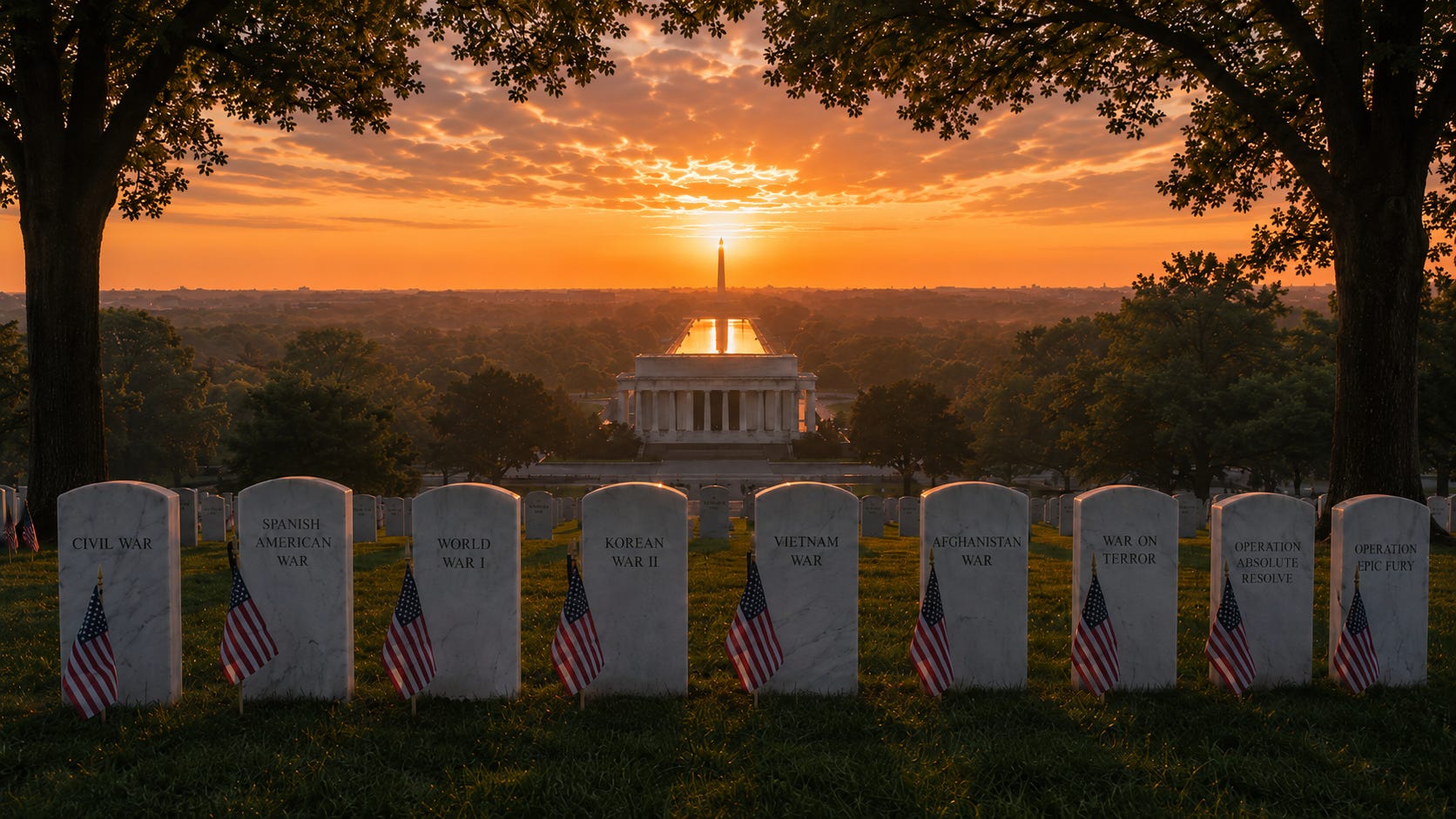
For the U.S. Memorial Day, officially the last Monday in May, I’m re-publishing my essay from last year that marked the holiday. Since then, the U.S. government has conducted one military operation and is in the middle of another in which armed forces personnel were either killed or injured:
Operation Absolute Resolve (0 killed; roughly 6–7 wounded/injured): A successful mission in January 2026 to capture President Nicolás Maduro and his wife, Cilia Flores, in Venezuela.
Operation Epic Fury (13 killed and 381 wounded so far). An ongoing mission that started on February 28, 2026 targeting Iranian leaders and defensive systems.
Most American citizens don’t really acknowledge the distinction between Veterans Day and Memorial day. Don’t get me wrong. We appreciate the two, three-day weekends, by attending parades, firing up the backyard grille for burgers and hotdogs, and maybe tipping our baseball caps to the veterans in the vicinity. This is all well and good.
But Veterans Day is a holiday that celebrates American military personnel. Memorial Day honors the fallen soldier. As author Tamra Bolton says,
“This is the day we pay homage to all those who didn’t come home. [Memorial Day] is not Veterans Day, it’s not a celebration, it is a day of solemn contemplation over the cost of freedom.”
A Memorial Day History
It all began almost immediately after the American Civil War (1861 to 1865). When the Confederate Army of Northern Virginia surrendered to General Grant at the Appomattox Court House in south-central Virginia, over six hundred thousand soldiers had perished; both from the Confederate and from the Union sides; at least two percent of the American population at the time; more lives than any conflict in U.S. history.
Just a month later, thousands of freed Black Americans in the ruined city of Charleston, South Carolina, commemorated a mass grave of union soldiers buried in an abandoned racecourse. 3,000 schoolchildren carrying roses, and hundreds of women carrying flower baskets with wreaths and crosses, sang the old Union marching song “John Brown’s Body” which is more famously known today as the “Battle Hymn of the Republic.”
By May the next year, 1866, according to Livia Albeck-Ripka of the NYTs, citizens of Waterloo, N.Y., “decorated their streets with flags at half-staff, draped with evergreens and mourning black.” The US Federal government, a century later, declared this commemoration as the official first Memorial Day.
That same year in Columbus, Mississippi, “women placed flowers on the graves of both Confederate and Union soldiers.” Just two years later, General John A. Logan, the commander in chief of the Grand Army of the Republic, a veteran of eight major civil war campaigns, established a national holiday with his signed general order number 11 saying,
“Their soldier-lives were the reveille of freedom to a race in chains, and their deaths, the tattoo of rebellious tyranny in arms.”
According to the USO (The United Service Organizations), on that date in May of 1868, “over 5,000 first-ever National Decoration Day participants decorated the graves of the 20,000 Union and Confederate soldiers buried at Arlington National Cemetery in Virginia.”
By the late 1800s, cities and communities across the United States began to observe the day and several states declared it a legal holiday. According to the New York Times, most referred to the day as “Decoration Day.” But as the country got involved in other wars (the Spanish-American War, World War 1, World War 2, the Korean war, and the Vietnam War), “Americans began referring to the observance as “Memorial Day,” not just to remember Civil War deaths, but to honor the American fallen from all wars.
In 1967, the U.S. Congress formally changed “Decoration Day” to “Memorial Day” and, in 1971, decreed that the holiday would land on the last Monday of May to ensure a three day weekend for federal workers.
Veteran Celebrations vs Memorials
But for me, it’s one thing to be a veteran of the US Armed Forces; a true and noble calling if there ever was one. It’s quite another thing though, to lay down your life in the name of a bigger idea; that all people are created equal, that they are endowed by their Creator with certain unalienable rights, that among these are Life, Liberty and the pursuit of Happiness. And, that to secure these rights, men and women must be ready to stand in the breach to protect them.
I’m reminded of President Franklin D. Roosevelt’s Bill of Rights proclamation in 1941:
“Those who have long enjoyed such privileges as we enjoy, forget in time, that men have died to win them.”
Or Winston Churchill’s WWII speech on the BBC about his citizen’s response in the Battle of Britain.
“Never in the field of human conflict, was so much owed, by so many, to so few.”
Or General George S. Patton’s hot take in 1945:
“It is foolish and wrong to mourn the men who died. Rather we should thank God such men [and women] lived.”
In President Lincoln’s condolence letter to Mrs. Bixby in Boston (She had lost five sons in the war), he succinctly expressed the country’s thoughts about our nation’s fallen sons and daughters:
“I feel how weak and fruitless must be any words of mine which should attempt to beguile you from the grief of a loss so overwhelming. But I cannot refrain from tendering to you the consolation that may be found in the thanks of the Republic they died to save. I pray that our Heavenly Father may assuage the anguish of your bereavement, and leave you only the cherished memory of the loved and lost, and the solemn pride that must be yours, to have laid so costly a sacrifice upon the altar of Freedom.
“… to have laid so costly a sacrifice upon the altar of Freedom.” That’s why we recognize Memorial Day.
And if you want to bring a tear to your idea, watch the scene from the movie, “Saving Private Ryan” where General George Marshall reads the letter. It gets me every time.
Many years ago, when I was in the U.S. Army, I was stationed at the Pentagon. My unit visited Arlington Cemetery, the cemetery where the country buries its veterans, the home of the Tomb of the Unknown Soldier. I was so moved by the experience that I wrote an essay about it. It’s called “Reborn at Arlington.”
Dramatization
At my last job, I worked at a small startup cybersecurity podcasting company called N2K. We dramatized the below essay with music and sound. I’m very proud of it. Take a listen if you get the chance.

Reborn at Arlington: An Essay
1,500 US Army soldiers stood on the misty parade field at Fort Meyer waiting for the sun to rise. The leadership had scheduled another morale building (yet mandated) “fun run” where once a quarter, the entire unit comes together to do PT (Physical Training) in a show of ésprit de corps and unit cohesion. Since we were all stationed at the Pentagon, many of us had been in the Army for a while. We were a little broken down in the body department and had seen our fair share of these types of events. There we were, at the twilight of our careers, huddled in small groups during the dawn of one more PT morning.
Of course, there was the usual grumbling between the older soldiers asking one another if we were motivated yet, and if we had a cup of ésprit de corps to spare. But there was a sprinkling of young soldiers among us too, and their shiny new faces kept us old timers from getting too cynical and fussy.
As the sun poked up above the horizon, the Army’s Command Sergeant Major called the gaggle to attention and the formation began to run. The Non-Commissioned Officers (NCOs) led the assemblage in rousing voice and extolled the virtues of Granny, My Girl, and the C-130. Below the roar of the singing, just in the background, you could hear the footsteps of the 1500 strong pounding the pavement in syncopated rhythm.
The formation crested the hill overlooking Arlington Cemetery and the vista of Washington DC opened up before us. The Army Colors, at the front of the formation, started their descent towards the Cemetery just as the rising sun reached the top of the Washington Monument several miles distant. And still the singing and the pounding drove the formation as it snaked down the hill towards the front gates.
As the colors passed into the Cemetery, like a line of dominoes falling, the singing faded away. One platoon after the other fell silent in mute honor of our fallen comrades-in-arms laid to rest in the National Cemetery. As the voices muted, the only sound you could hear was the constant beat, beat, beat of the run and the Army colors whipping in the slight breeze. Nobody spoke except for the occasional NCO keeping everybody in step with a steady, but quiet, 1 - 2 - 3 - 4, 1 -2 - 3 - 4. It was serene. It was sublime.
Midway through the run, the Command Sergeant Major called the formation to a halt and commanded us to execute a right-face towards the middle of the cemetery. The morning sun had burned off the last vestiges of mist from the manicured lawns. The breeze trickled through the formation’s silence and the Army Colors at the front. And then we all heard it; that mournful sound of a single bugler playing Taps. He began low at first; almost whispering the sound through the horn. But slowly, his crescendo wrapped the listener into a cocoon of sadness, memory, and gratitude about the lives that could have been, or that was. On that misty morning, young and old soldiers alike shed mutual tears as the bugler played on.
When it was done and the silence greeted the end of the song, a chill went down my back. It occurred to me that we were not merely taking a morning jog anymore. We were actually passing in review. These fallen soldiers, some of whom had given the ultimate sacrifice for their country, and others who were prepared to do so, were watching us and sizing us up. I hoped that we could pass muster. I had this great desire to let them all know that we had the guide-on now and it was in good hands. We would not let them down.
I stood a little taller then. My old muscles didn’t ache so much. As we began to run home, the burden was a little lighter. As 1500 boarded the buses to head back to the Pentagon, I realized that this old soldier was less cynical today; less worn for wear. Although I may not have the shiny face of one of those new soldiers, I was reborn this morning. Together, both old and young, we will carry on.
References
Abraham Lincoln, 1863. The Gettysburg Address [Speech]. Abraham Lincoln Online. URL https://www.abrahamlincolnonline.org/lincoln/speeches/gettysburg.htm
Amanda Onion, Original 2009, Updated 2023. Memorial Day 2022: Facts, Meaning & Traditions [Essay]. HISTORY. URL https://www.history.com/topics/holidays/memorial-day-history
Bob Zeller, 2022. How Many Died in the American Civil War? [Essay]. HISTORY. URL https://www.history.com/news/american-civil-war-deaths
Brent Hugh, 2021. A Brief History of “John Brown’s Body” [Essay]. Digital History. URL https://www.digitalhistory.uh.edu/active_learning/explorations/brown/music1.cfm
JOHN LOGAN, 1868. Logan’s Order Mandating Memorial Day [Order]. John A. Logan College. URL https://www.jalc.edu/admissions/logans-order-mandating-memorial-day/
Livia Albeck-Ripka, 2023. A Brief History of Memorial Day [Essay]. The New York Times. URL https://www.nytimes.com/article/memorial-day-history.html
Michael Burlingame, 1995. New Light on the Bixby Letter [Analysis]. Journal of the Abraham Lincoln Association. URL https://quod.lib.umich.edu/j/jala/2629860.0016.107/--new-light-on-the-bixby-letter?rgn=main;view=fulltext
Morgan Phillips, 2026. Seven US service members injured in Venezuela raid to capture Maduro, official says [News]. Fox News, URL: https://www.foxnews.com/politics/seven-us-service-members-injured-venezuela-raid-capture-maduro-official-says
Rick Howard, 2024. Memorial Day special. [Podcast]. The CyberWire. URL https://drive.google.com/file/d/1NKZr4k2H3goJ98NzXwFpu6fyvz3xA3QM/view?usp=sharing
Ryan C. Berg, Mark Cancian, Joseph S. Bermudez Jr., Jennifer Jun, Henry Ziemer, Chris H. Park, 2026. Imagery from Venezuela Shows a Surgical Strike, Not Shock and Awe [Analysis]. Center for Strategic and International Studies (CSIS), URL: https://www.csis.org/analysis/imagery-venezuela-shows-surgical-strike-not-shock-and-awe
Staff, n.d. Letter to Mrs. Bixby [Letter]. Abraham Lincoln Online: Speeches. and Writings. URL https://www.abrahamlincolnonline.org/lincoln/speeches/bixby.htm
Staff, 2020. A Brief Biography of General John A. Logan [Biography]. John A. Logan College. URL https://www.jalc.edu/admissions/a-brief-biography-of-general-john-a-logan/
Staff, 2024. Civil War Timeline [WWW Document], American Battlefield Trust. URL https://www.battlefields.org/learn/articles/day-civil-war
Staff, 2026. Pentagon data: 13 US troops killed, 346 wounded in Operation Epic Fury [News]. Military Times, URL: https://www.militarytimes.com/news/your-military/2026/04/08/pentagon-data-13-us-troops-killed-346-wounded-in-operation-epic-fury/
Thomas Jefferson, 1776. Declaration of Independence: [Transcription]. National Archives. URL https://www.archives.gov/founding-docs/declaration-transcript
Paul Robeson, 2021. John Brown’s Body [Song]. YouTube. URL
General George Marshall, 2014. President Lincoln’s Letter to Mrs Bixby [Movie Clip - Saving Private Ryan]. YouTube. URL