
The Death of Expertise

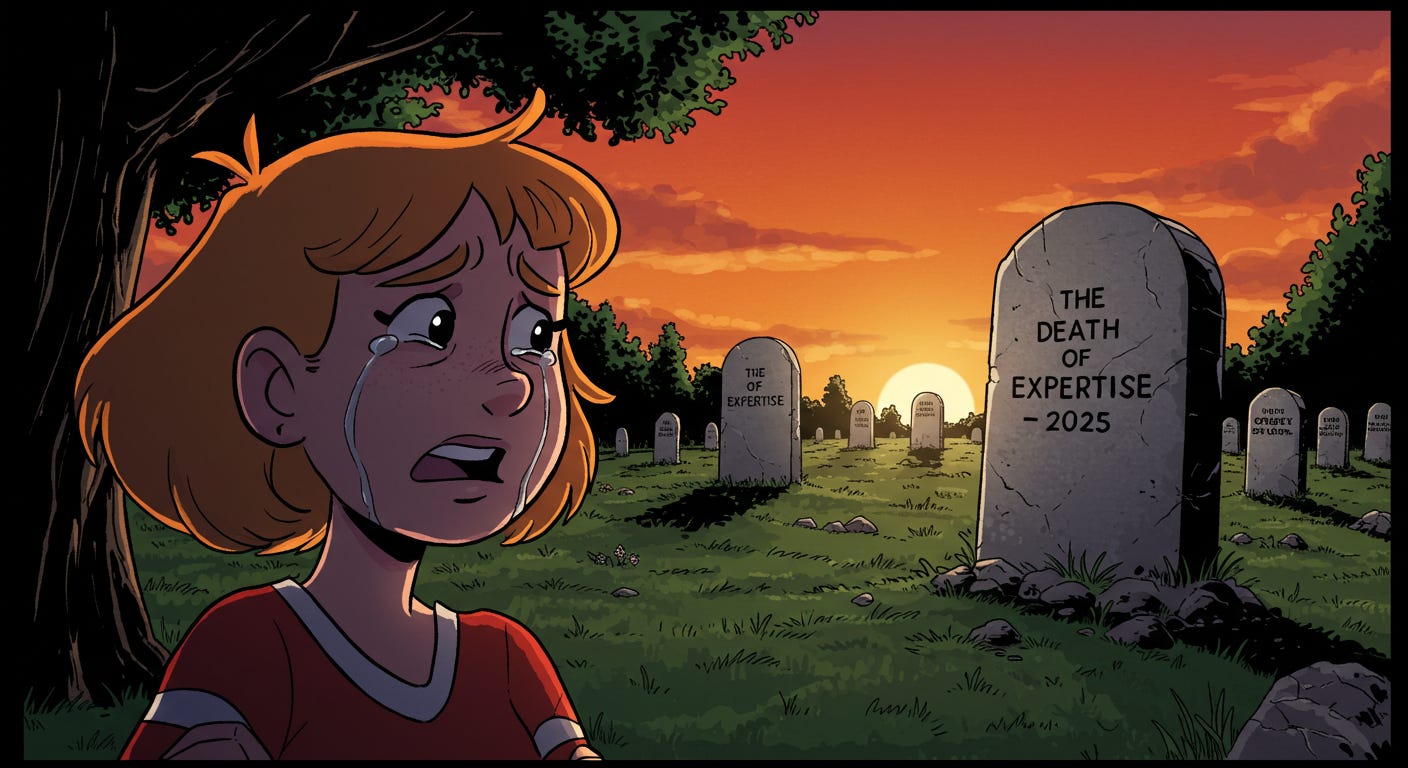
My two favorite podcast hosts for the past decade have been Malcolm Gladwell (Revisionist History) and Sam Harris (Making Sense). They both have recently launched screeds at Robert F. Kennedy Jr. (the current US Secretary of Health and Human Services) and Joe Rogan (host of arguably the most popular podcast on the planet). Gladwell and Harris have been on Rogan’s show as guests in the past and respect him for what he has built. But they are aghast that Rogan encourages people like Kennedy, and a huge gaggle of others, who repeatedly demonstrate an obstinate willingness to reject scientific consensus in favor of Uncle Fred’s 4chan conspiracy theory. Kennedy is a well-documented non-believer in vaccines, especially the COVID-19 vaccine, one of the greatest medical breakthroughs of any era and, by some estimates, credited with saving 20 million lives. And Rogan doesn’t just encourage these people. He condones it. His “I’m just asking questions” mantra somehow relieves him of any responsibility to hip-check his guests when they venture into crazy land.
We Don’t Trust Classic Experts but Amateur Experts are Everywhere
I’ve run into this in my own life, too. I have friends and relatives, as I’m sure you do, who have no specific expertise in anything, scientific or otherwise. But, they still feel compelled to vehemently declare that Dr. Anthony Fauci (one of the most distinguished infectious disease scientists in the world) is an idiot when it comes to what might work and what might not work to reduce the spread of COVID-19. Spoiler Alert: COVID-19 killed between 7 million and 22 million worldwide, depending on who you ask. My non-expert friends and relatives prefer a different approach to Fauci, though, because some guy on Facebook told them so (Do the Research!)
I get it. The Rogans and the Kennedys of the world don’t trust scientists anymore. We used to, in the old days, respect and admire them. Some of them were even household names like Albert Einstein (Relativity), Jonas Salk (Polio Vaccine), and James Watson & Francis Crick (DNA). The situation reminds me of the great opening scene from the HBO TV show, “The Newsroom,” written by Aaron Sorkin and acted by Jeff Daniels. Daniels is going off on the idea that America is not the greatest country in the world anymore, and he says this about the old days: “We aspired to great intelligence, we didn’t belittle it, it didn’t make us feel inferior.”
I’m not sure when this all changed, when we as a society changed our minds about that, but it’s probably when social media platforms became simple enough for grandma and grandpa (I’m looking at you, Facebook). Social media gave Uncle Fred an outlet and a means to find like-minded people.
What is Science Again?
There seems to be this notion in the air that since science doesn’t have all the answers immediately to some new problem (COVID-19 is the perfect example), or that individual scientists make mistakes in the research, then the logical inductive conclusion is that all scientific recommendations are bad and that scientists can’t be trusted. I don’t think Sherlock Holmes would approve of that argument. It shows a fundamental misunderstanding of how science works. The power of science is not in the individual scientist’s research. The power of science comes from the consensus of the scientific community.
Let’s assume that there is some validity to Uncle Fred’s 4chan conspiracy theory and that he has developed a robust experiment that tests his hypothesis. That’s one data point. Consensus comes later from other researchers running the same experiment and getting the same answer. The more times we substantiate the theory, the more confident we are that the theory is true. This process has been the engine of modern society since the early days. I’m reminded of the Richard Dawkins quote:
“If you base medicine on science, you cure people. If you base the design of planes on science, they fly. If you base the design of rockets on science, they reach the moon. It works. Bitches!”
That’s right bitches, it works.
The downside to the scientific process is that building consensus takes time. I just finished Candice Millard’s book on the assassination of President James Garfield: “Destiny of the Republic.” Garfield didn’t die because of his bullet wound. He died because of the massive infection that resulted from it. In a classic case of cosmic bad timing, Dr. Joseph Lister pioneered surgical antiseptic practices about 16 years before Garfield's assassination, but it hadn't caught on with the medical establishment. The medical community hadn’t reached a consensus yet on this new idea that invisible germs could kill somebody. Garfield’s doctors accelerated his death by poking their unwashed hands into the wound on multiple occasions over months of treatment.
How My Love of Science Mocks Me
The irony doesn’t escape me that Dr. Lister’s new antiseptic theory must have sounded like Uncle Fred’s 4chan conspiracy theory to the medical community at the time. All the old timers thought Lister was nuts. They weren’t going to change years of established medical consensus based on the results of that young whipper snapper. It took 10 more years to build enough consensus that surgical antiseptic practices became standard. If the assassin had shot Garfield then, Garfield would most likely have survived.
How I Think about Expertise
Where does that leave us then, when we think about expertise? Should we always abandon accepted scientific best practice for every new Uncle Fred 4chan conspiracy theory that comes down the pipe? That seems rash, even though those young whipper-snappers like Dr. Lister might be right once in a while. Even with the most promising ideas, we should still wait on consensus to be sure.
Should we abandon the scientific community’s expertise when scientists haven’t had time to come to a consensus yet? Remember, at the peak of the pandemic, the death rate was close to 15,000 people a day. We had to try something even though we knew we might make some mistakes. Do we automatically reject the best guesses of a Dr. Anthony Fauci, a man with over 55 years of infectious disease experience and who was the Director of the National Institute of Allergy and Infectious Diseases (NIAID) dedicated to that purpose? Of course not. That just seems stupid.
It comes down to probabilities. Knowing that mistakes will be made regarding whatever advice we pursue, what is the probability that Dr. Fauci and his staff at the NIAID might have a better idea about how to tackle the COVID-19 problem compared to Uncle Fred or compared to the one or two scientists who don’t go along with the consensus? I think that number might be big.
Until we come to terms with that, expertise may well stay buried for quite some time.
References
Candice Millard, 2011. Destiny of the Republic: A Tale of Madness, Medicine and the Murder of a President [Book]. Read by Paul Michael. Goodreads. URL https://www.goodreads.com/book/show/10335318-destiny-of-the-republic
Joe Rogan, n.d. The Joe Rogan Experience [Podcast]. YouTube. URL https://www.youtube.com/playlist?list=PLk1Sqn_f33KuS7ZSVMJqzFaqOyyl-esmG
Julio Guerrero, 2025. Opinions vs Expertise [WWW Document]. LinkedIn. URL https://bit.ly/3YdQb5I
Malcom Gladwell, 2025. The RFK Jr. Problem [Podcast]. Pushkin Industries. URL https://www.pushkin.fm/podcasts/revisionist-history/the-rfk-jr-problem
Malcom Gladwell, 2025. The Joe Rogan Intervention [Podcast]. Pushkin Industries. URL https://www.pushkin.fm/podcasts/revisionist-history/the-joe-rogan-intervention
Ryan Broderick, 2025. 4chan Is Dead. Its Toxic Legacy Is Everywhere [Analysis]. WIRED. URL https://www.wired.com/story/4chan-is-dead-its-toxic-legacy-is-everywhere/
Sam Harris, 2025. More From Sam": Religion, Deportations, Douglas Murray vs. Rogan, & Bill Maher’s Dinner with Trump [Podcast]. Making Sense. URL https://www.samharris.org/podcasts/making-sense-episodes/409-more-from-sam-religion-deportations-douglas-murray-vs-rogan-bill-mahers-dinner-with-trump
Sam Harris, 2025. The Whole Catastrophe: A Conversation with Douglas Murray [Podcast]. Making Sense. URL https://www.samharris.org/podcasts/making-sense-episodes/410-the-whole-catastrophe
Aaron Sorkin, Jeff Daniels, 2012. America is not the greatest country in the world anymore [Movie Clip]. The Newsroom - YouTube. URL
Richard Dawkins, 2017. Why we trust science [Interview]. David Thomson - YouTube . URL