
The Last Competitive Advantage
As everyone else races to consume summaries, the people who still read books will quietly pull ahead.

What Orwell feared were those who would ban books. What Huxley feared was that there would be no reason to ban a book because there would be no one who wanted to read one.
— Neil Postman, Amusing Ourselves to Death
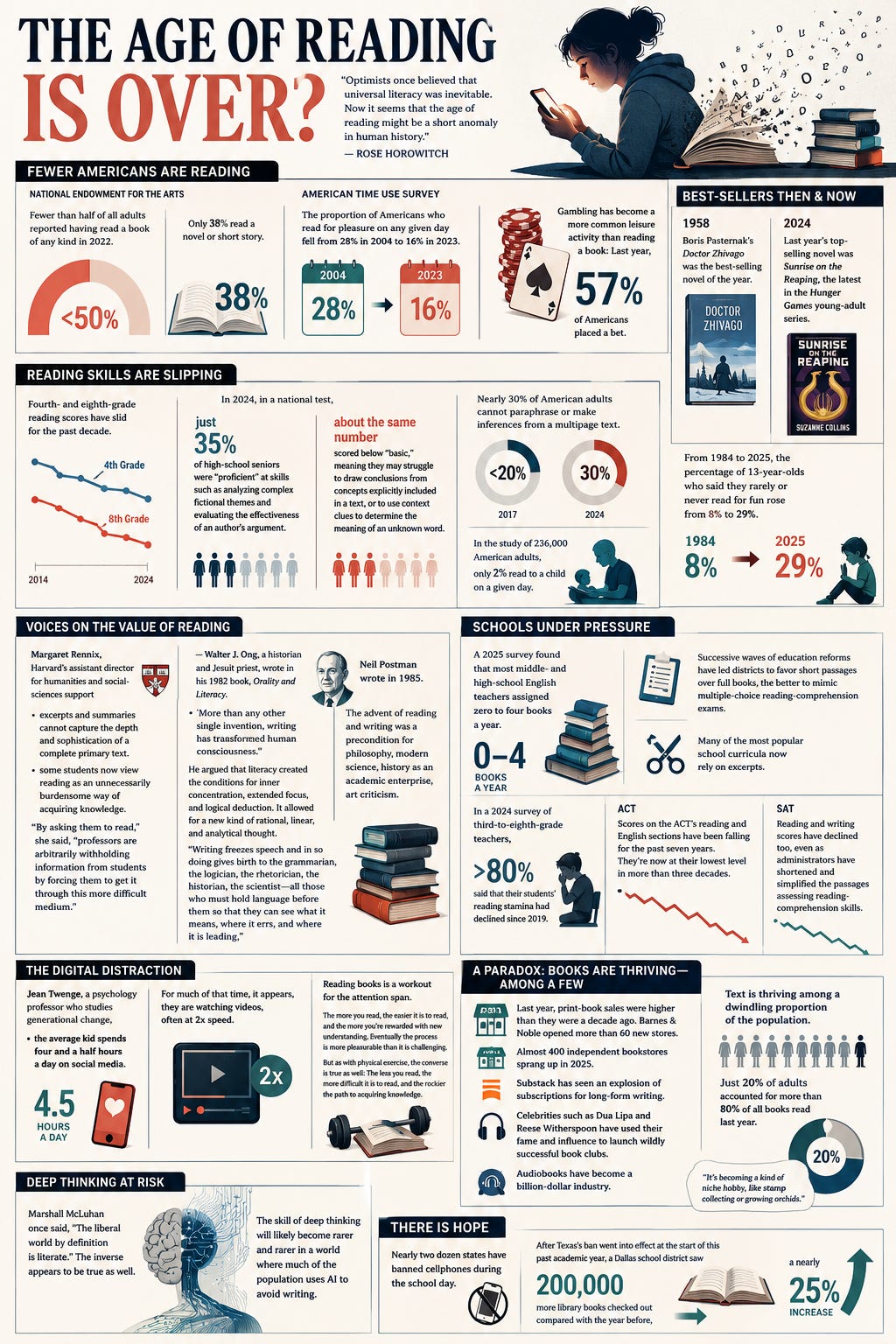
Rose Horowitch published The Age of Reading Is Over in the Atlantic last week. If you’re a book lover, the stats she presented aren’t good (See above).
Some would say this is a crisis, and maybe it is. But I think the situation is an opportunity. Hear me out.
Reducing her essay to a couple of main points, I would say that deep reading has become an elite skill instead of a universal one. Most people today find reading an optional exercise instead of a foundational one. Books aren’t dying. They’re becoming a niche activity practiced intensely by a minority. That puts book reading in the same leisure activity class as other niche activities like opera, chess, classical music, birdwatching, or long-distance cycling: healthy communities with passionate participants but limited mass appeal. The situation is not so much that people are reading fewer books; it’s that deep, sustained, analytical thinking, once cultivated by widespread literacy, has become the specialized skill of a shrinking minority.
When I Noticed the Problem
My background is cybersecurity. For the past 15 years, one of my jobs has been to visit customers. You all know that I love to read books, but on those trips, I noticed that my peers had stopped doing that. Generally, they didn’t read books for fun, but more importantly, they had never really read any of the foundational cybersecurity books; books that shaped the great ideas of our profession.
I’m not judging. There are many good reasons why this is the case. The one big one is that the industry pumps out incredible amounts of content each year in the form of vendor blogs, podcasts, YouTube videos, white papers, and yes, books.
So Much Material
Although I couldn’t find an industry number from a reliable source, ChatGPT estimates that the number of published cybersecurity books each year is somewhere between 1,000 and 1,500 if you count certification guides, lab manuals, and exam-prep books. If you’re looking for quality, deeply researched books about a specific cybersecurity topic, the number is probably between 150–300 annually. That’s a lot of books. I don’t read 150 books a year. I’m lucky if I get 30 in total. And that includes all of my guilty pleasure vampire and zombie novels and my recent passion, Dungeon Crawler Carl.
So I get it. We are all overwhelmed. In order to stay current in our profession, our natural tendency is to try to get through as much material as possible. The impact is that we don’t read books anymore. We read summaries of books. We listen to podcasts on triple speed. We use AI to summarize YouTube videos.
Don’t get me wrong, summaries are useful. They have their place. But here’s the thing. To really learn something new, or to re-learn something that you thought you knew, you have to slow down. I know that sounds counterintuitive, but it’s the truth. You have to wallow in the material. Engage with it. Take notes. Decide if you agree with the author or not. Maybe even write about it.
Margaret Rennix, Harvard’s assistant director for humanities and social-sciences support, argues that “excerpts and summaries cannot capture the depth and sophistication of a complete primary text.” Ouch! That sounds so elitist, so snobbish. I get where she’s going but let me try to make her point in another way.
Bloom’s Taxonomy on Learning
Summaries compress information, but they also compress thinking.
When I taught computer science back in the 1990s, my teaching partner and I did a lot of research about how to teach. One framework that appealed to us was Bloom’s Taxonomy. We used it as a roadmap for moving students from knowing something to thinking deeply about it (See chart below).
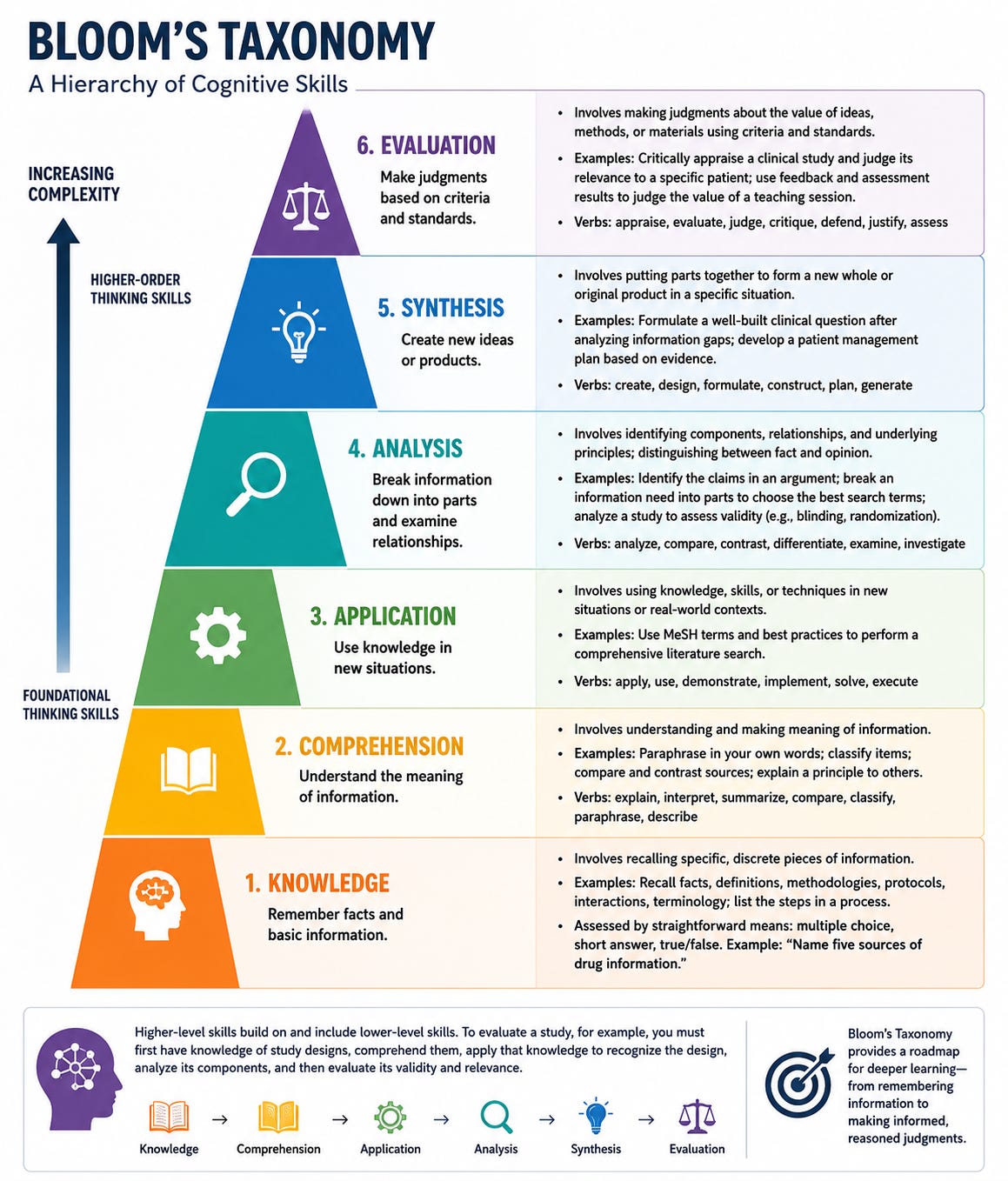
When students begin learning about a new knowledge domain, they occupy Bloom's Knowledge stage. They recognize terminology and can recall facts, definitions, and procedures, but they have not yet developed a conceptual understanding of how those pieces fit together. As they develop, they learn to explain concepts in their own words (Comprehension) and apply those concepts correctly in new situations (Application). As problems become more complex, they learn to break them into their component parts, identify relationships, and understand why a solution works or doesn’t (Analysis). From there, they begin creating new ideas, designs, or solutions by combining what they have learned in novel ways (Synthesis). Finally, they develop the ability to evaluate competing solutions, defend their conclusions with evidence, and explain why one approach is better than another (Evaluation).
To simplify, Bloom’s Taxonomy maps the journey of an elementary school student all the way to a PHD student in one knowledge domain. When we taught computer science back in the day, we designed our lessons to move students as far up Bloom's Taxonomy as the subject matter and available time would allow.
Here’s my point. When you are reading a summary of a book, instead of reading the actual book, you are at best at the comprehension stage of Bloom’s; maybe the Application phase if you are already familiar with the knowledge domain. But if you’re trying to learn something new to develop your professional career, logically, you want your knowledge domain expertise to be at the Synthesis and Evaluation levels, not the Knowledge and Comprehension levels. You want to be able to use the knowledge to help solve problems.
The Opportunity
The decline of reading presents an unexpected opportunity. As fewer people are willing to wrestle with long, complex arguments, the ability to do so becomes increasingly scarce. Scarcity breeds value. In a world awash in summaries, videos, and AI-generated explanations, those who continue to read deeply will possess an asymmetric cognitive advantage over those who merely consume other people’s conclusions.
I’ve said for years, if you read one book on a subject, you’re likely the smartest person in the room on that subject because, as Horowitch says, nobody reads books anymore. If you’ve read two books on that same subject, you’re in a set of maybe 500 people in the world who are “The Experts” in the field. You’re not in the top 10, for sure, but you’re in the conversation when somebody asks, “Who should we talk to about this?”
Takeaway
Ironically, Claude Fable articulated the dilemma better than I could:
The more AI floods the world with instant answers, the more the deep reader becomes the rare person who can ask better questions, spot what the summary missed, and tell the difference between knowing about something and actually understanding it.
-- Claude Fable, June 2026
We're living through a rare moment when a clear opportunity arises. We are at the proverbial fork in the road. One path follows convenience (summaries); the other is strategic (book reading). Over time, the people who choose the second path are far more likely to become the experts, the people executives call when the problem is difficult and the stakes are high. That’s the opportunity. That’s the advantage.
So keep using AI. Keep listening to podcasts. I know I intend to do that. But don't let those tools replace the hard work of reading, of reaching for the top levels of Bloom’s Taxonomy.
The old proverb says, “In the land of the blind, the one-eyed man is king.” If Horowitch is right, then in the age of AI, the deep reader becomes the one-eyed king
Source
Rose Horowitch, 2026. The Age of Reading Is Over [Essay]. The Atlantic, URL: https://www.theatlantic.com/magazine/2026/08/reading-crisis-postliterate-age/687618/
References
Alex, 2026. Atlantic Story is absolutely frightening [Comment]. Alex & Books - Substack, URL: https://substack.com/@alexandbooks/note/c-290622997
James Marriott, 2025. The dawn of the post-literate society [Essay]. Cultural Capital - Substack, URL: https://jmarriott.substack.com/p/the-dawn-of-the-post-literate-society-aa1
Nancy Adams, 2015. Bloom’s taxonomy of cognitive learning objectives. [Paper] Journal of Medical Library Association. 103(3):152-3. doi: 10.3163/1536-5050.103.3.010. PMID: 26213509; PMCID: PMC4511057. URL: https://pmc.ncbi.nlm.nih.gov/articles/PMC4511057/
Noah Friedman, Jason Reynolds, 2026. Kids can’t read anymore. Does it matter? [Podcast]. NO SUCH THING, URL: https://www.nosuchthing.show/p/debunking-the-reading-crisis-jason-reynolds
Virginia Clinton-Lisell, 2022. Listening Ears or Reading Eyes: A Meta-Analysis of Reading and Listening Comprehension Comparisons [Academic Paper]. ResearchGate, URL: https://www.researchgate.net/publication/356615999_Listening_Ears_or_Reading_Eyes_A_Meta-Analysis_of_Reading_and_Listening_Comprehension_Comparisons