
Wait and Hope:
Why You Should Finally Read The Count of Monte Cristo

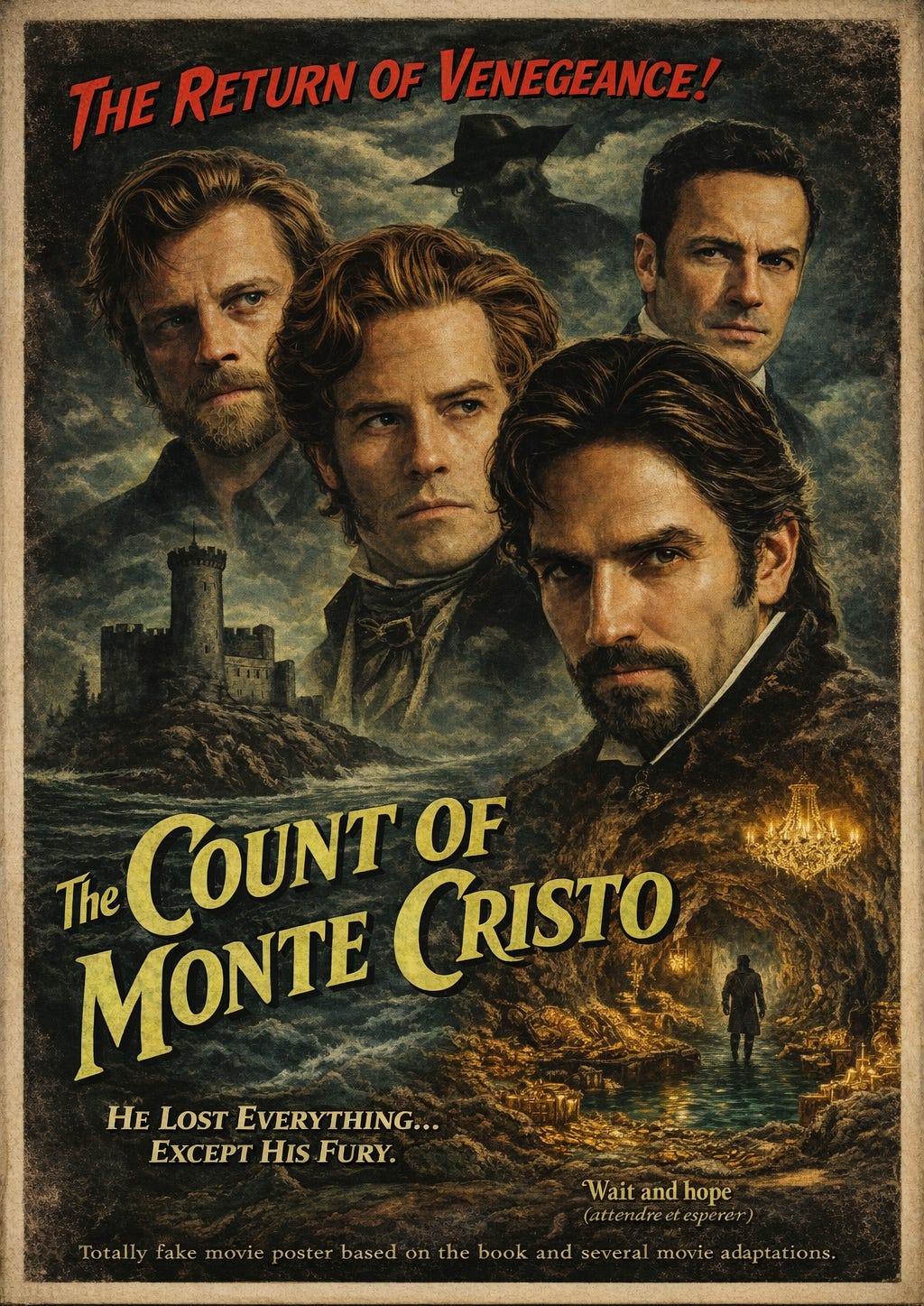
If you have been putting off The Count of Monte Cristo because of its length, I am here to tell you that you are right to be scared and wrong to keep waiting.
Alexandre Dumas is an author I feel like I have always known about but have never read. His most popular novels (The Three Musketeers, The Man in the Iron Mask, and The Count of Monte Cristo) have well over 100 screen adaptations combined if you count silent films, TV movies, series, miniseries, and international productions. But I have never read any of the books. Over the New Years holiday, one our close family friends said that she was reading it and loving it, so I thought I would give it a try.
I’m glad that I did because it is an entertaining and complex soap-opera-revenge-story set in and around Italy and France just before and after the French defeated Napoleon at the Battle of Waterloo in 1815. But it is long; 60 hours of audio long. It took me three months to get through it. And there are a bazillion characters to keep track of. And as good as Dumas is, I had trouble keeping everybody straight.
The setup is relatively simple, but the execution of it is complex. A young Edmond Dantès is sabotaged by three colleagues and one magistrate over the jealousy of his fiancee, the envy of his promising naval career, indifference, and political self-preservation. His enemies frame him for a crime he didn't commit and send him to prison forever. While in prison, he meets an older-man-father-figure who teaches him various languages, math, philosophy, and the analytical framework that lets Dantès understand the conspiracy. Just before their get-away, the old man dies but not before he reveals the location of his secret treasure. Heartbroken, Edmond escapes anyway, recovers the treasure, and takes another 10 years planning his revenge. He shows up in Rome and in Italy as the Count of Monte Cristo, maybe the most wealthy person on the planet, and starts to pull the strings of his revenge plan on his four targets.
The Count disgraces Fernand Mondego so badly that Mondego commits suicide.
He exposes Gérard de Villefort’s hypocrisy to the world. The impact is that Villefort loses his family and goes insane.
He gives Gaspard Caderousse a chance to reform but Caderousse can’t stay on that path. He dies as a direct consequence of returning to crime.
He financially ruins Baron Danglars by preying on his greed. Danglars becomes a pauper but, at the end of the book and with a feeling of remorse, the Count spares his life.
Dantès carries out most of his revenge, but when innocent people suffer, he recognizes he’s gone too far. He spares Danglars, abandons further vengeance, and turns toward mercy rather than trying to justify his role as divine justice.
And I will say, Dumas sticks the landing. All of those bazillion characters I was talking about have a satisfying arc. And the resolution to it all is hopeful. The Count abandons the role of avenging angel, acknowledges he is not God and cannot perfectly administer justice, and in the final pages, delivers his final philosophy: wait and hope (“attendre et espérer).
But let me address the book’s length. Newspapers paid Dumas primarily through serialization contracts. Payment scaled with output volume, not literary minimalism. Expansive plots and large casts sustained serialization. The system rewarded length and continuity, so verbosity had economic upside. Dumas wasn’t counting words but he was absolutely operating in a system where more content = more money.
Dumas was one of the first “industrial-scale” novelists in history. He ran his writing career like a production company. He worked with collaborators, like Auguste Maquet, who would draft outlines, build historical scaffolding, and sometimes produce early versions of chapters. Dumas would then rewrite heavily, add dialogue, pacing, and injected iconic flair that made these kinds of books popular. He essentially built a content pipeline, 150 years before Hollywood writers’ rooms or modern media franchises.
He made enormous money but spent it faster than it was coming in. He built the extravagant Château de Monte-Cristo outside Paris, hosted constant parties, funded friends, and lived big. He was in perpetual debt and eventually exiled himself to Belgium to avoid creditors. He orchestrated numerous affairs and begat several children. He was financially reckless, socially dominant, politically engaged, and personally chaotic. And that combination is exactly why his books feel so alive. To adapt Thoreau’s Walden,
He lived deep and sucked out all the marrow of life.”
And by the way, the man could write.
Source
Alexandre Dumas (Author), Robin Buss (Translator), Bill Homewood (Narrator), 1844. The Count of Monte Cristo [Book]. Narrated by Bill Homewood. Goodreads. URL https://www.goodreads.com/book/show/7126.The_Count_of_Monte_Cristo
References
Kevin Reynolds (Director), 2002. The Count of Monte Cristo [Movie]. Letterboxd, URL: https://letterboxd.com/film/the-count-of-monte-cristo-2002/
KimMiE, 2025. The Count of Monte Cristo by Alexandre Dumas [Book Review]. Cannonball Read, URL: https://cannonballread.com/2025/04/the-count-of-monte-cristo-kimmie/
Other Books by Alexandre Dumas
Alexandre Dumas, 1844. The Three Musketeers [Book]. Goodreads, URL: https://www.goodreads.com/book/show/7190.The_Three_Musketeers
Alexandre Dumas, 1847. The Man in the Iron Mask [Book]. Goodreads, URL: https://www.goodreads.com/book/show/54499.The_Man_in_the_Iron_Mask
I actually read "The Count of Monte Cristo" when I was about 12. There was a set of his works at my grandmother's house and I read it one summer. Then I inherited the set (21 novels in 25 volumes (!) from 1910). "The Count" is still the only one I've read to date, but they are on my list!