
Why I Bounced Hard Off A Wrinkle in Time

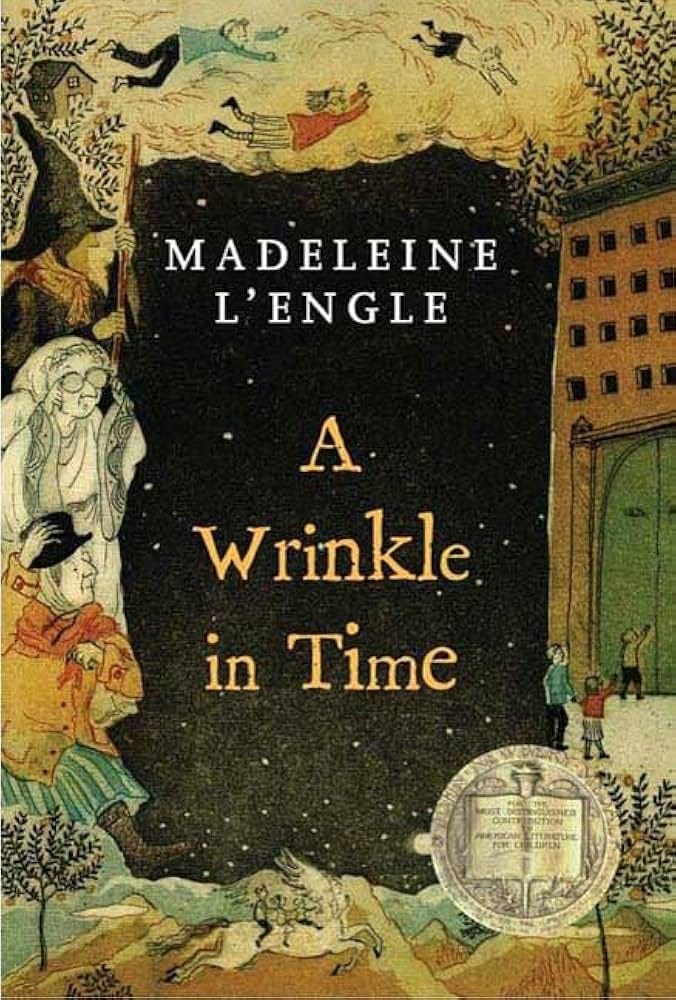
I didn’t expect A Wrinkle in Time to fail a basic parental sanity check, but it did.
In the Apple TV series Ted Lasso, Trent Crimm ( The Independent) gives a Twitter Line book review of A Wrinkle in Time. He says, “it’s the story of a young girl’s struggle with the burden of leadership as she journeys through space.” I don’t know what book Trent Crimm was reading, but it wasn’t the one I read.
I wasn’t expecting a sci-fi–fantasy fairy tale. Science fiction, yes. Fantasy, maybe. But a fairy tale in which immortal beings, after failing for centuries to defeat a great evil, send underage children to confront it, armed with nothing more than a pair of magic glasses and a few words of encouragement, fully aware that the children have little chance of success and a high probability of dying? And then, after barely escaping for their lives with a rescued dad in tow, the dad turns around and sends his daughter back in by herself to fetch her stupid brother?
Uh ... I don’t think so. I can see why kids might like the story but “my” dad-hat was sitting firmly on my head and there is no way that I’m sending my daughter out by herself to face the ultimate evil. No parent would. I don’t know what I was expecting but I know it wasn’t that and I didn’t like it.
I did appreciate that L’Engle published it in the early 1960s and her ideas were ahead of their time. Back then, science fiction readers consumed stories about adults dismantling societies through intellect and ideology (Stranger in a Strange Land), mathematicians predicting civilizations (Foundation), and adults grappling with power, ethics, and technology (A Canticle for Leibowitz). A Wrinkle in Time is written in the language of science with children interacting and understanding tesseracts, relativity, higher dimensions, and psychological control. And she just expects her audience to go with it. I liked that part.
Back then, we were still feeling the impact of fighting off a totalitarian system (Nazis in WWII) and were worried about another one (Stalinism). Nuclear annihilation was plausible and imminent. George Orwell’s 1984, published in 1949, was on everybody’s mind in the West, and there was a real fear that we might slide into a similar dystopia The great evil in this book represented totalitarianism, mind-numbing conformity, and no freedom of thought. L’Engle was saying that this is something to defeat by all means, like we did with the Nazis; even sending your daughter in alone is justified. I think many parents reading it for the first time like I did, would bounce off that idea hard.
But many people love this book. It did win three literary awards:
Newbery Medal (1963)
Sequoyah Book Award (1965)
Lewis Carroll Shelf Award (1965)
Clearly, many readers see something here that I don’t. But for me, two stars. It had some good parts but not enough for me to recommend it.
As a fairy tale, I guess A Wrinkle in Time works. As a story I’d trust with my kids though, it leaves me uneasy and that’s not nothing.
Source
Madeleine L’Engle, 1962. A Wrinkle in Time [Book]. Read by Hope Davis, Ava DuVernay, Madeleine L’Engle, and Charlotte Jones Coiklis. Goodreads. URL https://www.goodreads.com/book/show/33574273-a-wrinkle-in-time
AWIT was the first book I read in which I was totally transported into a realm of my own mind. It was 1979, and I was in 6th grade. I started reading it on my bus ride home from school, and I was so absorbed, I missed the stop at my house. I didn’t even realize that I remained on the bus after all the other children had departed, I was so absorbed. I eventually read everything L’Engle published.
I get the concern you have from the perspective of a parent, but the book was written to inspire young readers to consider the dangers of conformity, hate, and manipulation. Instead, it offers an opportunity, however fantastic, for young readers, especially young girls, to consider how powerful they are even in their immature selves, and how much more powerful they will be when they become adults if they retain the essential characteristics of people who desire to do good. L’Engle’s characters follow this arc in her later novels that involve the Murry and O’Keefe children. It’s a coming of age story that hints that age does not have to be the end of wonder and innocence, that love must transcend conformity to segregation, and that children have the potential to understand and participate in many adult concepts, not just the questions of ethics and morality already mentioned here, but also deep physics and math. For a young, gifted 6th grader deeply passionate about science and math and who had been recently relocated to small cloistered middle Georgia town experiencing the last convulsions of Jim Crow racial segregation, growing up in a quasi-cult, and surrounded by southern anti-intellectual authoritarianism, AWIT provided a fantastic thought experiment about how to confront that environment and others like it. I continued to think about the implications of that book on my life for 46 more years.
Of course AWIT was fantasy. The point of fantasy is to enter a world where the usual rules don’t always hold, and then present to the reader a character they can identify with who is placed in a situation from which they cannot escape unless they do something they are usually constrained from doing, like thinking deeply and unconventionally, and acting with courage. The Hobbit, The Lord of the Rings, The Wizard of Oz, Star Wars, and many others all follow this structure. Even less fantastical stories, like The Hardy Boys, Nancy Drew, and (my favorites) The Three Investigators and Danny Dunn: Scientific Detective were also a kind of fantasy in which children often faced dangers that their adult counterparts couldn’t quite help them with and they couldn’t escape from unless they applied the principles I described above. It’s not this way because adults are cynical, incompetent, fearsome, or untrustworthy (although we all know that many of them are), but because it presents a relatively safe environment (the reader’s mind) to enter the world of adult concerns and consider that the concerns of adults are worth participating in eventually rather than remaining forever in the safe, cordoned, and fluffy environment of the nursery. Of course AWIT was fantasy. That’s the point. As a parent I also gave these stories to my children as a gift for growing up.