
Everyone Is Performing in Pride and Prejudice
Proud men may be honorable, charming men may be corrupt, and the smartest woman in the room may still be wrong

Jane Austen’s great trick is not asking whether Elizabeth and Darcy will fall in love. It is asking how anyone can judge character when charm, manners, money, and reputation are all unreliable evidence.
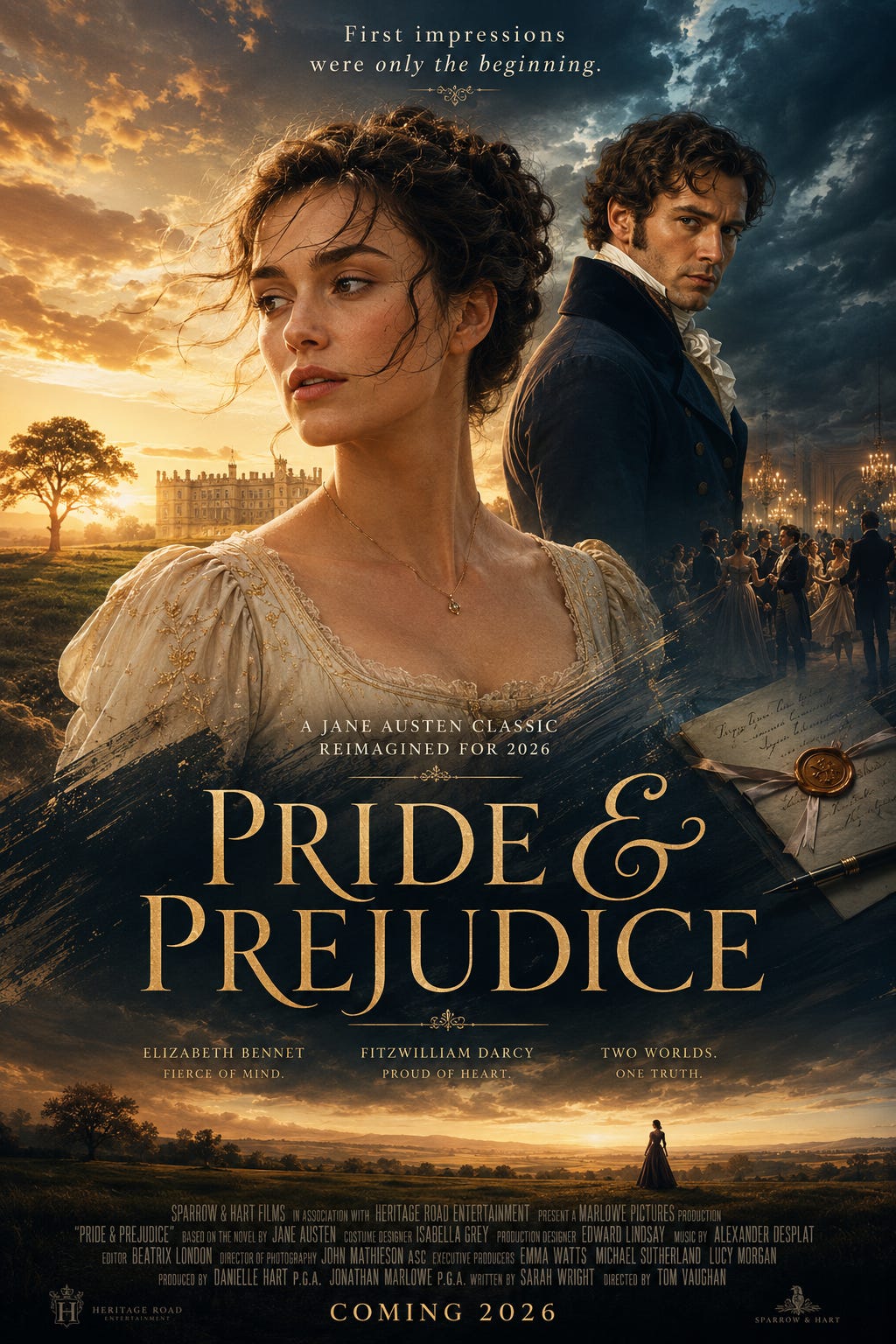
I’ve been on a kick lately to go back to the books I was supposed to read in high school but never did. You know, the classics. This year I plowed through “The Count of Monte Cristo;” 60 hours in audio format. It was a slog but ultimately worth it in the end. The author, Alexandre Dumas, stuck the landing.
While I was doing that, the 2005 movie, “Pride & Prejudice” popped up in my Amazon Video algorithm feed starring Keira Knightley and Rosamund Pike and I love those two actors. I didn’t watch the movie though. But it got me thinking though. Why is it that I haven’t seen any of the 11 direct film or TV adaptations including the early BBC versions, the 1940 MGM film, the 1980 and 1995 BBC miniseries, or this 2005 film. Clearly, this Jane Austen story has some staying power. If you include modernized, loose, sequel, parody, and inspired-by versions, the number of adaptations (like Bride and Prejudice, The Lizzie Bennet Diaries, Pride and Prejudice and Zombies, Fire Island, Bridget Jones’s Diary, and You’ve Got Mail) climbs to over 20. Why wasn’t I interested? I figured I would take a look at the original book and see what all the fuss is about. Rosamund Pike reads the audiobook too: bonus!
I Hate Stories about Rich People
Before I start, I just want to say that when I read novels, I’m looking for adventure. I’m not looking for realistic, trigger-inducing family drama. I get enough of that in my own situation. And I absolutely don’t care to consume entertainment about the troubles of rich people (See the TV series “Succession” or “Downton Abbey”). I think it’s the reason I’ve avoided Jane Austen novels my entire life. Without reading a single page, I thought P&P was just a soap opera about insanely wealthy people. I was completely wrong.
A Sign of the Times
The main character is Elizabeth Bennet, the second of five daughters in a family of minor landed gentry. That means that the family is not obscenely rich, but close enough that they regularly look over the horizon to people and families who are. They have a real existential problem though: inheritance law. Because Mr. Bennet has no male heir, the estate will pass to a distant and disliked male cousin when he dies. So, while the wider world was dealing with Napoleon, Regency politics, industrial disruption, imperial slavery, and an approaching Anglo-American war, the Bennet family, especially the mom, was fighting its own domestic campaign to find husbands for the daughters before the estate disappeared beneath them. And, if at all possible, they all needed to marry up in the class structure, not down.
That’s not a criticism. It’s just the way it was back then. Women had severely limited economic agency unless they married a man of means. The Bennet daughters need good marriages not merely to climb the social ladder, but to avoid falling off it once their father dies.
So, that sounds like a pretty run-of-the-mill family drama about rich people. Then why do literary scholars consider “Pride and Prejudice” a classic?
Why is “Pride and Prejudice” a Classic?
I believe it’s because Austen is an expert guide in showing the absurdity of it all: the societal rules that families and daughters absolutely can’t break (manners, money, marriage, reputation, power), the class structure that humans invented and can’t seem to uninvent, and the fact that everybody just goes along with it. It helps that Elizabeth and her rich love interest, Mr. Darcy, are flawed, make mistakes, learn from the consequences, and change their ways. And not for nothing, Elizabeth is one of English literature’s great heroines. She is, as they say, a strong woman: intelligent, funny, strongly opinionated, and willing to change her mind when she realizes she has made a mistake. Her presence alone elevates the material to another level.
The entire story orbits around the idea of destroying first impressions. How do you distinguish the real person hidden behind the societal dance of manners and protocol? Some people look proud but are honorable. Some look charming but are corrupt. Elizabeth and Mr. Darcy’s first impressions are badly mistaken, and Austen takes the entire novel to show them recognizing their errors and changing their behavior. Her working title was First Impressions, and that is the mechanism of the book: everyone is performing, everyone is judging, and the smartest people are still wrong.
Takeaway
That is why the book still works. Austen is not merely asking whether Elizabeth and Darcy will get together. She is asking a harder question: how do you know what a person is worth when charm, manners, money, and reputation are all unreliable evidence? In the end, “Pride and Prejudice” is still about the trials and tribulations of rich British people. But Austen elevates the genre with her keen sense of what is really going on behind society’s polished facade.
Source
Jane Austen, 1813. Pride and Prejudice [Book]. Goodreads, URL: https://www.goodreads.com/book/show/129915654-pride-and-prejudice
References
Jesse Armstrong (Creator ), Brian Cox, Alan Ruck, Jeremy Strong (Actors), 2018. Succession [TV Series 2018–2023]. IMDb, URL: https://www.imdb.com/title/tt7660850/
Joe Wright (Director), Keira Knightley, Rosamund Pike, Carey Mulligan, Donald Sutherland (Actors), 2005. Pride & Prejudice [Summary Page]. Letterboxd, URL: https://letterboxd.com/film/pride-prejudice/
Marvin Mudrick, 1952. Jane Austen: Irony as Defense and Discovery [Analysis]. Internet Archive, URL: https://archive.org/details/janeaustenironya0000marv_r5n5/page/n5/mode/2up
Michael Engler (Director), 2019. Downton Abbey [TV Series]. Letterboxd, URL: https://letterboxd.com/film/downton-abbey/
Mordecai Marcus, 1961. A Major Thematic Pattern in Pride and Prejudice [Analysis] Vol. 16, No. 3, pp. 274-279, University of California Press. URL: https://www.jstor.org/stable/2932646
Rick Howard, 2026. Wait and Hope: The Count of Monte Cristo [Book Review]. First Principles Newsletter Substack, URL: https://diffuser.substack.com/p/wait-and-hope
Thanks Rick. Another great classic broken down. Another classic I don't need to read. Although the audio book, read by Rosamund Pike sounds exrtremely good. You are the best!